THE FINAL END
by: areeon foreman



.jpg)
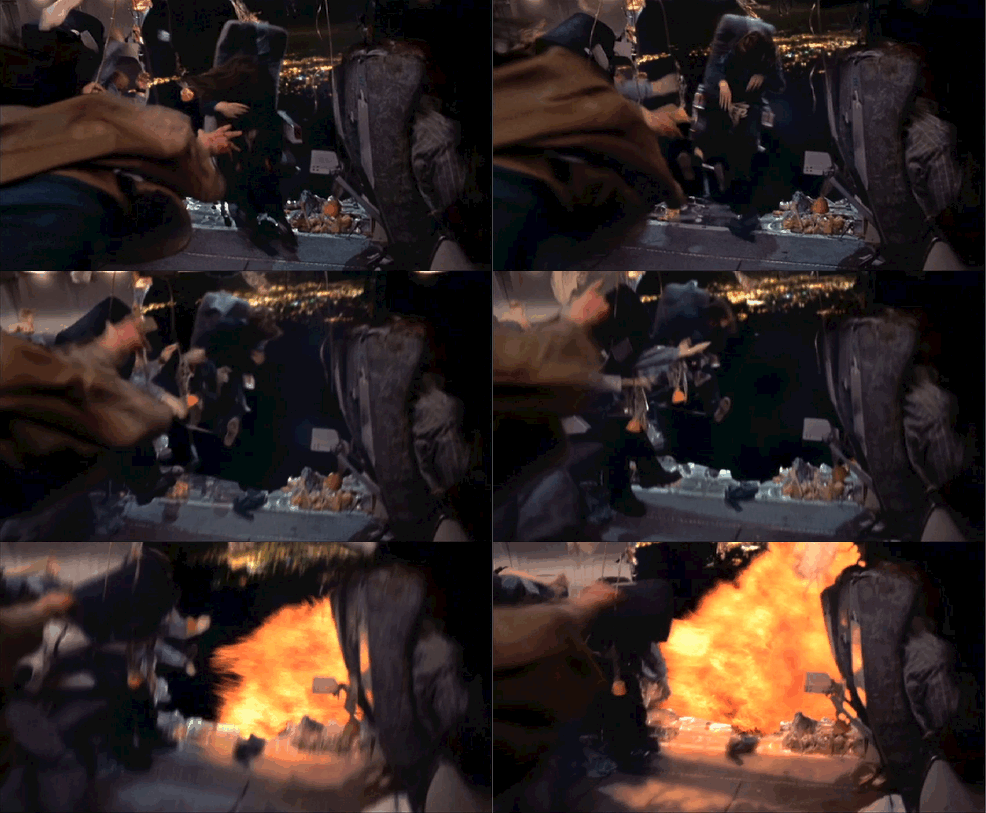
Death is a sensitive subject to many people in terms of discussing it. However, people can not shy away from it as it is broadcast on television, movies, videogames, books, etc. With this, a franchise has made a way to not only poke fun at it, but it makes it less scary. In 2000, James Wong commenced the Final Destination series as he shows each person dying in a unique freak accident with the message being nobody is truly safe from death. However, the films portray that if a person escapes death the first time, they cannot get away from it again. The Final Destination films raises questions as can a person truly escapes death or is their fate already sealed after they escape it the first time? Brendan Morrow says that the killer in The Final Destination series “isn’t a specific man or monster whose return must be explained. No, the killer is death itself, an invisible antagonist who will be taking lives until the end of time” (Is ‘F.D’ the Best Horror Franchise in History?). Final Destination series has created a franchise feeding off death as a silent killer. No one can see death, but death makes its present known. With showcasing these elaborate death scenes with each of the characters that survived the near- death experience, it should show that death is not as dramatic as it is portrayed. To support my claims, I will be using Final Destination series 1, 2, and 5 to go into depth about how people that escaped death the first time could either be waiting for it to come or live their everyday life as normal, if a character’s fate already sealed on whether their destined to die now or later or just a coincidence and what happens when death decides to change the rules of the game, putting the players on edge. The purpose of this essay is to help the audience see that they do not have to view death as a bad thing. The Final Destination series uses death as an entertainment source for the audience’s amusement and a sense of confidence. Due to this, it makes the franchise a success as more movies are to come.
When it comes to death, it will happen to everyone one way or another. In Final Destination series, death is the main theme. With the main character in each of the films, they have a premonition of an accident that is about to occur and starts to warn people about it. Because of this outbreak, the main character has a tendency to save some other people including themselves. Due to this, the characters all cheated death. However, just because they escaped it the first time, does not suggest that they can do it again. When death decides to attack the victim, it focuses on the person’s background to make it more realistic. Emily von Seele argues that even though the character's death is not seen throughout the series, it still watches the individual from afar. Due to this, it changes how the individuals react to their surroundings as death builds a plan to kill them (Final Destination- Death and the Inescapable Boogeyman). After the characters survive the near-death experience, some of them a have a tendency to continue their normal daily life or live on the edge of when death will strike them. This relates to other people in real life as they have death anxiety (worrying about dying). William Breitbart who works in a nursing home, experiences death hands on. He advises that the blessings of denial are to prevent us from being overwhelmed through the loss of life terror, accordingly permitting us to assimilate and even accommodate the reality of our deaths at a conceivable pace (276). People usually seem to live in denial as they suppose that death will not happen to them. By blocking it out of their mind, people tend to be more at peace with it. However, death is something that everyone will experience, whether they prefer it or not. However, displaying the elaborate over the top death scenes in Final Destination series, it indicates the entertainment side of it. Dr. Rieger from the University of Mannheim and Dr. Hofer from the University of University of Zürich argue that in an entertaining horror films it serves as a tension buffer best if the protagonist is still alive at the end of the film (712). This provides the audience a scene of comfort due to the fact that some of the tragic accidents that happen to the characters are less likely to happen to them and also whether the main character at the beginning of the film survives throughout the end. It also gives the audience a glimpse of hope that death is not as scary as it is portrayed.
Fate is out of human control. When someone’s fate is sealed, then it is final. Final Destination films exhibit that each individual in the film's fate was already in place once they escaped the accident that would have killed them. However, what if that was not their fate all of long? But instead, they were just simply destined for something else. Hugh Rice from Stanford University argues that when it comes to fatalism, no one truly has the power over anything or anyone. But instead, it is the mental state of the time in the world that people question (Fatalism). When people look at certain events, there is a question of whether or not God intended for that event to happen or the person just so happens to be there at the time. Eric Strachan, Tom Pyszczynski, Jeff Greenberg and Sheldon Solomon argue that the expertise of life, blended with a know-how and anticipation of the future. This results in the inevitable end that no matter how life is constructed, it will ultimately end in death, possibly in a death this is excruciatingly painful that might come at any time (18). This approach means that whether or not fate plays a role, death will come to a person either way. However, Ian Conrich says that the characters in The Final Destination films are sufferers that are part of a preordained plan or scheme, and the deaths are regularly hyper-elaborate. These are essentially survival horrors and puzzle to second guess the system wherein the horror that awaits may be tortuous and protracted (Puzzles, Contraptions and the Highly Elaborate Moment). It is said that the characters have been already destined to die from the very beginning of the film. This idea is verified in Final Destination series as certain individuals are at a location at a certain time. When the accident occurs and some people live through it, other characters start to question if they were meant to live all of long or die in the accident. Either way, the characters that lived after, eventually dies in the end, slowly sealing their fate one by one. With the main character, their fate is questionable. An example of this is viewing the first Final Destination film. The main character Alex Browning lived throughout the whole film. However, this fact changed when it is revealed in the second movie with the aid of another survivor of the first film that Alex passed away due to a brick falling on him. This information shows that despite the fact that though the audience do not get to see what happens next for the main characters such as Alex in the other franchise films, their life still lives on. With Alex, even though he survived throughout the film, his fate became sealed in the second one without broadcasting it to audiences. Fate can be problematic in a few cases, especially in Final Destination series. It mainly suggests that a person can live to inform the other about their experience, however, their life can come to an end is a blink of an eye.
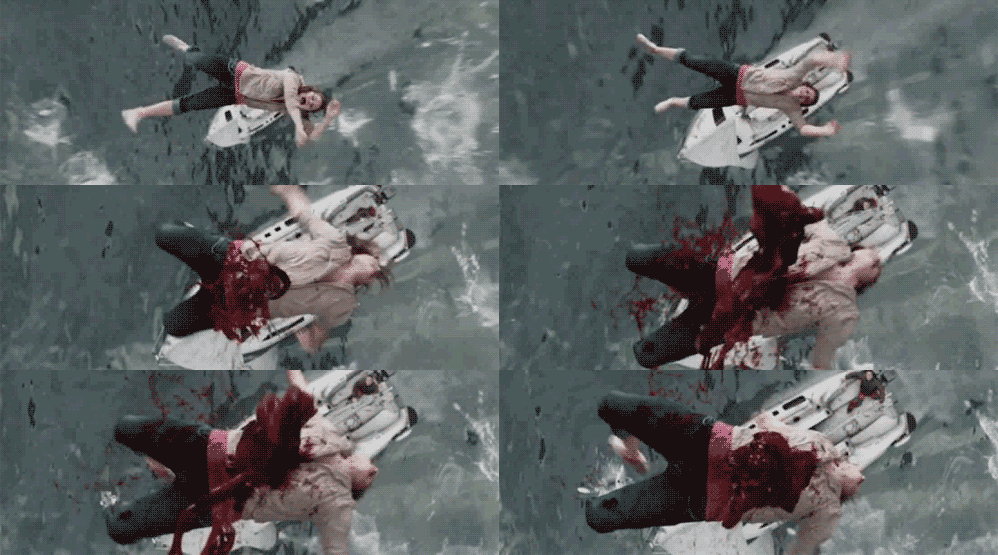
Death is seen as a mastermind within the twisted game as it kills each of the players one by one. Death can also change the rules of the game as well. In Final Destination 5, there is a game-changer as the main character Sam Lawton discovered that him and the others can actually survive if they play the game proper. Jack Wilhelmi from the Screen Rant argues that this particular film showcases the idea that murdering a person would provide the killer the potential to absorb the rest of their ultimate lifespan (Final Destination 5 Retconned The Series’ Death & Murder Rules). Wilhelmi says that that death can spare a person’s life mainly if that person was never meant to die in the first place. An example of this is in Final Destination 2, a pregnant woman's life became spare given that she was carrying a child. It was later revealed that she was in no way met to die the whole time, saving herself from playing in death’s game. Death has the upper hand in all of this and the characters mainly try to find loop holes if they can, but at the end, death always comes up as the winner. Another example consists of another survivor from Final Destination film, Clear Rivers. Although she did not die in the first film, does not mean she is secure from death. It is just that death could not get to her due to the fact that Clear positioned herself in a mental institution. Clear tells the main character in Final Destination 2 Kimberley that death does not need to go in order to kill certain people, it can choose people at random or go backwards. This reveals that if death does not get the person the first time, it will simply wait until the time is right to get them again. This makes death the ultimate winner in it game wants the character to find a way to cheat because it apart of the game. However, there is no cheat codes and it is revealed that death will come to the characters one way or another because death has all the time in the world.
When contemplating death, people tend to think about it in the worst way possible. However, James Wong shows death off in entertainment as he created Final Destination films. Tom Reimann from Collider says that inside the film, it mainly consists of death stalking the characters within the films, mainly subjecting them to convoluted accidents that regularly play out like comedy routines (Evert Death in the Final Destination Series). In my essay, I have used The Final Destination series 1, 2 and 5 to support the following pieces of evidence: providing how people in the film live life after escaping a near-death experience and how it connects to people in real life who worry about dying. In Final Destination films, it provides the audience comfort as they see the other characters’ death and the main character living throughout the film. How fate plays a part in a person’s life on whether they had been destined to die the whole time or simply it was just a coincidence. However, it is revealed that the other character’s fate was already sealed as soon as they escaped death the first time whereas the main character’s fate is undetermined until the end of the film. Finally, death decides to changes the rules in the game when the other players learned that they can actually cheat death the second time. But over time, the characters learn that it is just a part of death’s game as he wants them to learn this information. Final Destination franchise feeds off of death as it turns it into some comical for the audience to watch and have a laugh due to the graphic scenes that are shown throughout the film. Dr. Filippo from the National Louis University says that people “should view life and death as together forming the complete cycle of human existence” (9). Death should not be taken seriously as it will happen to everyone. It is broadcasted daily as people see that one day, their time will come. However, it will not be as graphic as Final Destination film broadcasts.
Work Cited Page
Breibart , William. “On the Inevitability of Death.” Cambridge University Press, vol. 15, no. 3, June 2017, pp. 276–278.
Conrich, Ian. “Puzzles, Contraptions and the Highly Elaborate Moment: The Inevitability of Death in the Grand Slasher Narratives of the Final Destination and Saw Series of Films.” Style and Form in the Hollywood Slasher Film, edited by Wickham Clayton, Palgrave Macmillan, 2015, pp. 106-117.
Final Destination 2, Directed by David R. Ellis, performed by Ali Larter, A.J Cook and Michael Landes, Zide/ Perry Productions, 2003.
Final Destination, Directed by James Wong, performed by Devon Sawa, Ali Larter and Kerr Smith, Zide/ Perry Productions Hard Eight Pictures, 2000.
Final Destination 5, Directed by Steven Quale, performed by Emma Bell, Miles Fisher and Tony Todd, New Line Cinema, 2011.
Morrow, Brendan. “Is 'Final Destination' the Best Horror Franchise in History?” Bloody Disgusting!, 14 Apr. 2016.
Reimann, Tom. “Every Death in the Final Destination Series, Ranked.” Collider, 17 Mar. 2020.
Rice, High. “Fatalism.” The Stanford Encyclopedia of Philosophy, editied by Edward N. Zalta, Metaphysics Research Lab, Stanford University, Winter 2018.
Rieger, Diana, and Matthias Hofer.” How Movies Can Ease the Fear of Death: The Survival or Death of the Protagonists in Meaningful Movies.” Mass Communication and Society, vol.20, no. 5, 2017, pp. 710-733.
San Filippo, David Ph.D. “Philosophical, Psychological & Spiritual Perspectives on Death & Dying” Kimball Publishing, 2006, pp.5-24.
Seele, Emily von. “Final Destination' – Death and the Inescapable Boogeyman.” Bloody Disgusting!, 1 Dec. 2017.
Strachan, E., Pyszczynski, T., Greenberg, J., & Solomon, S. “Coping with the inevitability of death: Terror management and mismanagement”. Coping with stress: Effective people and processes. Edited by C. R. Snyder. Oxford University Press, p. 114–136.
Wilhelmi, Jack. “Final Destination 5 Retconned The Series' Death & Murder Rules.” ScreenRant, Screen Rant, 30 Mar. 2020.




.jpg)